

What it is
Veneers are thin restorations bonded to the visible surface of teeth to adjust colour, shape, length or small gaps.
What it can help with
They can address persistent staining, worn or chipped edges, uneven shapes and minor spaces that whitening alone cannot correct.
Four things at once, in a few appointments
Some issues neither whitening nor orthodontics can solve. Veneers address all of them together.
Colour
Stubborn staining, internally darkened teeth or shades that do not respond to whitening.
Shape
Small, worn or chipped teeth, or a shape you have never liked.
Gaps
Diastemas or small spaces between teeth that orthodontics would take months to close.
Symmetry
Uneven edges or a smile that looks misaligned even when the teeth are healthy.
How it works
We assess the bite, design the result digitally, prepare the tooth only if necessary, and fit porcelain or direct composite restorations.
Which type of veneer fits your case
Porcelain
Maximum naturalness and stain resistance, custom-made in a laboratory. The most durable option: 10–15 years or more with good care.
Best if: you want the longest-lasting, most stable result.
Composite
Applied directly in the chair, in fewer appointments and at lower cost. Reversible in most cases, though it needs periodic polishing.
Best if: you want a more affordable change or prefer a reversible option.
Micro-veneers
Ultra-thin laminates with minimal or no reduction of the natural tooth, where anatomy allows.
Best if: preserving your own tooth structure is the priority.
Who it may suit
They may suit adults seeking a defined aesthetic change whose teeth and gums are healthy and whose bite can support the restorations.
Veneers, whitening or orthodontics?
If it is only the colour
Whitening is simpler, cheaper and does not touch the tooth. Starting there is usually the sensible move.
If it is the position
Crooked teeth or a misaligned bite are better solved with orthodontics. Veneers cover, they do not move.
If it is shape and colour together
That is where veneers are the most direct solution: both corrected in a few appointments, without months of treatment.
Many plans combine several stages — aligning first and placing veneers afterwards, for instance. We tell you honestly, even when it means starting with the cheaper option.
Benefits and limitations
Porcelain is durable and stain resistant; composite is more repairable and usually less costly. Any tooth preparation must be considered carefully.
Why Clínica Lubens
We recommend the least invasive option that can meet the goal and show the intended proportions before you commit.
Want to see your smile before you decide?
Book an assessment: we study your case and show you the proposed result with Digital Smile Design.
Your clinical team
Your treatment is carried out by clinicians with relevant training and experience. Their languages and professional registration are shown below.
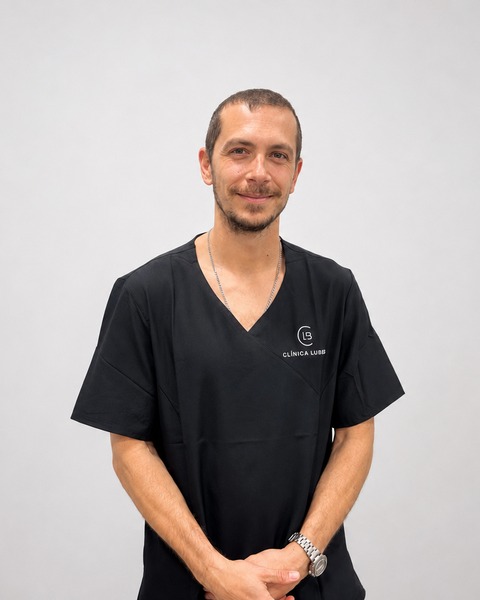
Dr. Alejandro Cordero
- Languages
- Español, English, Português
- Registration
- COEV 46005753
Common questions
- Porcelain or composite?
- Porcelain usually offers greater stain resistance and longevity; composite is more repairable and can be more conservative. We help you choose based on your case and budget, not on what costs most.
- Do teeth always need drilling?
- No. Some cases need little or no preparation, while others require controlled reduction for a safe, natural profile. We tell you exactly what your case needs before you decide.
- How long do veneers last?
- Well-maintained porcelain veneers often last 10–15 years or longer, but bite, habits and hygiene matter. Composite usually needs polishing or touch-ups every few years.
- Will people be able to tell?
- Properly planned and custom-made, no. The aim is a smile that suits your face and your age, not a row of identical, artificially white teeth.
- Can I eat and live normally with them?
- Yes. Once fitted you eat and speak as usual. It is worth avoiding biting ice, opening things with your teeth or nail-biting, exactly as with a natural tooth.
- What if I grind my teeth?
- We assess that first. Placing veneers without addressing active bruxism shortens their life considerably; in those cases we usually include a night guard as part of the plan.
- Are they reversible?
- Composite veneers usually are. Porcelain veneers that require preparation are not — which is why we insist on previewing with Digital Smile Design and will not place them if you are not convinced.
- Can veneers be whitened later?
- No: whitening only works on natural tooth. So if you want a lighter shade, we do that before making the veneers, so the final colour is uniform.
Your assessment at Clínica Lubens
- We listen to what is bothering you and review the relevant history.
- We examine your mouth and recommend imaging only when needed.
- You receive clear options and a written estimate before deciding.